Physical Address
304 North Cardinal St.
Dorchester Center, MA 02124
Physical Address
304 North Cardinal St.
Dorchester Center, MA 02124

I’ve never been someone who’s been very interested in puzzler games; I’ll play a few rounds of Tetris or Puyo Puyo with friends in a casual setting, but aside from that, I’ve never cared much for the genre. That actually changed a few months ago when I was with a friend at an arcade. I was walking around looking for games to play, and there was one small cabinet in the corner of the arcade that looked to be one of those SNK Arcade Candy Cab Machines. I don’t know the exact model, but this machine had three different games to choose from. I don’t remember the other two games, but the third one—Magical Drop III—drew me in because the art style was really cute.
I played a few games against CPU players and found the game to be quite addictive. My friend was waiting for me, though, so I only played for a bit, but I remembered what the game was called. So, when I got home, I did some research on the game and downloaded a ROM for the PlayStation version. I was hooked. I was so hooked that I devolved into researching the history and lore of the series, checking out the competitive scene, looking up supplemental media, and drawing fan art. And because of that, you’re going to be subjected to another one of my schizophrenic rants— I mean reviews. So I hope you enjoy listening to me talk about my current favorite puzzler game, Data East’s Magical Drop III.
Data East Corporation (データイースト株式会社, lit. Dēta Īsuto Kabushiki Gaisha), also abbreviated as DECO, was a Japanese gaming company that was founded on April 20th, 1976, and folded in June of 2003. You may know them for their Arcade classics like BurgerTime, Treasure Island, Karnov, and Joe & Mac.

The company started as an electronic engineering company, and released their first game in July of 1977: Jack Lot was a Blackjack-inspired arcade game designed for business use only. In the following year, they released their first arcade game with a public release, Super Break. Allegedly, this title was a clone of Atari’s Breakout; a revision called Super Break 2 was released later in the same year.

In 1980, Data East introduced the DECO Cassette Systems, an arcade system that made use of interchangeable media, similar to how home consoles could make use of interchangeable cartridges. This was huge back in the day: if an arcade wanted a different game in a certain cabinet, it only required a cassette and key module. No more changing out entire motherboards or cabinets! Unfortunately, one of the biggest problems with this was the performance of the cassettes. They’d run into mechanical errors, took a long time to load, and wore down fast.
Data East soon abandoned this idea in ‘85, but released over 40 games in this format before then. Despite this though, this idea would form the basis for other arcade systems like the Nintendo Vs. System.
Aside from that, Data East would also buy licenses to sell games from other developers. When they shifted to working on console games in 1986, Data East USA became the first third-party company to produce games on the NES. This would also cause Data East to expand more with different gaming genres. They had a relatively good run, releasing games that would become cult classics on many 8 and 16-bit systems, in addition to arcades.

However, by the end of 1996, the company’s American division, Data East USA, was liquidated, and its final releases were Defcon 5 and Creature Shock: Special Edition. Soon, the Japanese company announced it would be leaving the arcade industry in 1997, with Magical Drop III being their last arcade release.
In 1999, Data East stopped making video games altogether and went back to electronic engineering and licensed some of their older games to other companies, with the last game that had Data East’s name on it being Magical Drop Pocket. Unfortunately, none of their efforts were enough to save the company from its crippling debts, and they filed for bankruptcy in 2003, with most of Data East’s gaming library being acquired by G-Mode. This mobile gaming company is a subsidiary of Marvelous.
Despite that, though, Data East’s old titles still live on today as ports for modern consoles, and you can still find many of them in retro arcades. Data East also cultivated a passionate enough following that the IPs that were acquired by other companies would get modern sequels or HD remakes, such as Windjammers.

The inception of Magical Drop came to be in the same way many other wonderful pieces of media came to be: a Russian game for MS-DOS. In 1992, two companies called Xor-Laboratory and Russ Ltd. released a puzzler game called Drop-Drop. In this game, the player controls a cursor that can be moved from left to right across seven columns. The player can grab and throw tiles from a predetermined board, and the objective is to match five or more of the same tiles of the same image. These images include a blue sphere from Sonic 3, a sun, a rose, a green donut, a rabbit, a four-pointed star, a leaf, a balloon, and several others. When you match five or more of the same image tiles, it will be added to your score, and the game will end once a tile reaches the bottom of the screen.

This game was included in the Moscow Knights game compilation and released in the UK and Germany. Data East eventually came across Moscow Knights, obtained a license for Drop-Drop, and used its general gameplay as an outline of what would eventually become Magical Drop. In Magical Drop I and II, Russ Ltd. was credited for the gameplay, and a lot of Japanese material refers to Magical Drop as a Russian-style puzzle game. But by the time the third game came out, Data East would purchase the full rights to the game from Russ, and they would cease to credit them in the following games.
Before continuing, I wanted to explain some terminology. Specifically, the difference between a Puzzle game, a Puzzler, and a Vs. Puzzler. A puzzle game is kind of an umbrella term, and just refers to any general game that has puzzle elements, problem-solving elements, or even math-based aspects; think of something like an ice puzzle in a Pokémon game, matching a specific piece of evidence with a specific line in Ace Attorney, or figuring how to take on specific enemy formations on the higher difficulty modes of FE12.

A Puzzler game is a game where the object of the game is exclusively based on puzzle solving and getting a high score; no points, no quills, or anything like that, just straight puzzle solving. An example of a game like this would be something like Tetris, Sudoku, Candy Crush, or a Rubik’s Cube. A Vs. Puzzler is essentially the same concept, but the objective is now based on beating an opponent, which is what a lot of popular games in the genre fall into, like Puyo Puyo, Bust-A-Move, and Magical Drop.

Now then, in 1995, Magical Drop I was released in the arcades as Data East’s attempt to try their hand at the action puzzler genre. This game was based on a modified version of Drop Drop, which revamped a lot of the mechanics, designs, and aesthetics. Rather than the basic black layout of Drop-Drop, Magical Drop was a lot more vibrant and colorful.

It also featured a colorful cast of characters, all based on Tarot Cards. Let’s start with The Fool: one of two simple, free-willed brothers who speak in cat noises. The Fool that appears in Magical Drop I is the taller brother who is seen holding a flower, but the one seen in later games is much shorter and carries an emotional support cat with him. He’s somewhat of the series mascot and is consistently the weakest character in each game, usually being your first opponent in the single-player mode. But he doesn’t really mind. He’s just happy to be here.


The next character we have is The Magician: a narcissistic, self-proclaimed ladies’ man who, despite his overconfidence, does have the magical skill and looks to match his words. In-universe, he is described as someone whom others love to hate. In Japanese, he speaks in an old-fashioned manner, frequently ending his sentences with “de aru,” a formal and old-fashioned variation of the term “desu.”

Next, we have the beautiful High Priestess, an arrogant and slightly snobby scholarly woman. She loves to read and is almost always accompanied by a book, and sometimes with reading glasses. Like The Magician, High Priestess speaks in a somewhat antiquated way, punctuating a lot of her sentences with the catchphrase “zamasu,” an archaic Japanese term used by old, snobby rich women. Most of the descriptions in the manuals describe how arrogant she is, with one describing how it’s almost charming how domineering she is. One thing about the manuals that isn’t consistent, though, is how they can’t seem to make up their mind whether she’s interested in Astronomy or Astrology.

Next, we have The Chariot, a hot-blooded spear-wielding shounen protagonist. Brimming with drive and ambition, he loves martial arts and fighting. Outside of his design, there isn’t much about him that really stands out to me. Though apparently he’s bald under his helmet.

After him, we have The Devil, a bratty kid who likes to cause mischief; he does a little bit of trolling. Like most zoomers, he has a short attention span, gets bored easily, and hates studying magic. He has a similar verbal tic as The Magician and The High Priestess, where, in The Devil’s case, he ends most of his sentences with “Damoon.” In one of the English versions of the second game, he also swears frequently, using words like “damn” and “hell.”

Lastly, we have The Star: a ditzy, tone-deaf girl who loves to sing. She has a very bright smile and is very peppy, and despite her love for singing and practicing every day and night, she’s stated to be absolutely terrible at it. It’s played for laughs, but it’s kind of depressing, honestly. She’s also referred to by some players as “Jugs” because… she’s always holding two jugs of water. Aside from that, she’s also notable for placing an overemphasis on the phrase “desu” in her speech.

In the game’s single-player mode, you also encounter the non-playable boss character, The World, after defeating The Magician. The World is described as an alluring and elegant goddess who oversees Magical Land. She’s a polite woman who has three eyes, short pink hair, and a green ribbon protecting her modesty.
The manual for Magical Drop III describes her hobbies as… bathing. Wow, very interesting, I’m so glad the manuals can give us such much-needed lore. Aside from that, if you were active on the internet in like 2005, a particular winning animation of The World seen in Magical Drop III may be familiar to you, as it was a popular meme back in the day, spawning a ton of edits and recolors and used in many sites as forum emotes, banner ads, and the like.

Shifting to the game’s mechanics, the playfield consists of two 7×14 grids, one for each player. Each player controls a little clown at the bottom of the screen, though in some versions, like the Super Famicom version, you instead control a small version of your character. Meanwhile, balloons will appear from the top of the screen, and you can use the clown to grab and throw balloons directly above you. There are four different colors for balloons: red, yellow, blue (or purple), and green. Your clown or character is also able to grab multiple balloons of the same color and throw them all at once.

Your objective is to match three or more of the same colored balloons in a column. When you match the balloons, all the matching balloons are popped, and the balloons fall upwards to fill in any empty spaces, potentially creating more matches.
Creating a chain of 2 or more sets will result in garbage being sent to your opponent’s board. Aside from the standard balloons, there are also Burst Balloons, designated by a little icon in the middle of them. If you match three or more Burst Balloons, it will clear your board of every balloon of the corresponding color. The particular color of the special balloon that spawns on your board is also determined by the specific character you choose. And fun fact, the special balloon symbols in the game are the suits of Spanish and Italian playing card games; cups, clubs, gold, and swords, and are considered minor arcana in tarot readings.
The other type of balloons, Ice Balloons, are considered colorless balloons, and they’ll only pop if you make a match of three or more other balloons adjacent to them.
There are two ways to win a game of Magical Drop: either filling your opponent’s board with so much garbage that it reaches the bottom of their screen or reaching your “Quota” first. Quota is a predetermined number, and when you get a match, your Quota decreases by the number of balloons you just popped. If you reach 0 Quota first, you win.
When Magical Drop I came to arcades in the West and Europe, it was renamed to Chain Reaction. One of the most notable things that came with this localization is that all of the Japanese voice acting was removed in favor of more generic voice clips of an announcer. Another change is that all the balloons were instead replaced with various items. For example, in the multiplayer mode or when playing against The Fool, they’re replaced with food items. This was done to better make the game appeal to the more overweight Western audience.
Another example is that when playing against the Star, the balloons are replaced with stars, clouds, suns, and moons. And when playing against the High Priestess, they’re instead diamonds, hearts, clubs, and spades. Magical Drop I was also rereleased on the Super Famicom, Sega Saturn, and PlayStation 1. The PS1 version was bundled with Magical Drop III and included some extra modes. The Super Famicom version also received a fan translation by Aeon Genesis.

Magical Drop II was released in arcades in 1996. The arcade version of MDII was developed for SNK’s Neo Geo hardware, as opposed to Data East’s proprietary Simple 156 System, the first game was developed for. MDII introduced several gameplay changes, a change in art direction, new unique character themes, new game modes, and new characters.

The most notable gameplay change is with the way Burst Balloons work. Now, Burst Balloons don’t need to be matched with other Burst Balloons to make them work; instead, they can just be matched with regular balloons of the same color, although they still have to be grabbed separately. The game also introduces Crystal Balloons, which can be used to fill in for any color, like a wildcard. Additionally, they will clear the board of any balloon of that color. Lastly, there are Arrow Balloons, which also serve as a wildcard, and will pop all the balloons in the direction the arrow is facing.

The overall gameplay was also sped up a bit, and the pattern layouts were also revamped quite a bit to encourage an emphasis on speed rather than intense strategy. The sprites and animations are also a lot more vibrant and lively, and the characters have more dialogue and expanded ending scenes that give them more personality.
In this game, all the characters from the first game return; The World was made into a fully playable character, and The Devil is now unlockable. The first new character is Justice, a blonde-headed hero with a big ponytail, a big sword, and a big heart. The sword on her back is aptly called the Justice Blade, and she carries it everywhere. Her hobbies include fighting to eradicate evil and training to eradicate evil. Like The Chariot, she’s very hot-headed and driven, but is also not super interesting. The two have somewhat of a rivalry with one another, even having the same mentor according to the canon.

Aside from The Devil, the two other unlockable characters include Strength and The Empress. Strength is a muscular brute who serves The Empress alongside The Devil. Despite his appearance and alignment, he’s shown to be a caring and sentimental guy, particularly in Magical Drop III.

Lastly, the Empress is a spoiled and sadistic dominatrix who serves as Magical Drop II’s final boss. She wears leather, holds a whip, and has the iconic Ojō-sama laugh. In the game’s single-player mode, she holds the Magical Drops and uses their power for evil, and it’s your job to take them from her. She loves being the center of attention and enjoys recruiting others into her army. Despite her initial impression, though, she’s shown to be very juvenile and petty; in Magical Drop III, her evil deeds never really go beyond insignificant pranks. She’s the type of person to call herself a “bad bitch,” then the badness in question is drinking straight from the carton and leaving the seat up.

After defeating the Empress, though, you discover that she was being corrupted by a dark magical force. Her normal form is depicted as a caring and kindhearted woman with a more modest appearance. The evil force controlling her belongs to a character named Black Pierrot, a secret non-playable boss character who can only be encountered if the player defeats Empress without using a continue. He’s one of the few characters who aren’t based on any particular Tarot Cards, and his design is just a small little clown guy, similar to the ones you control. Black Pierrot isn’t like the other clowns, though; he wears black.

Magical Drop II was rereleased on the Super Famicom and the Sega Saturn, and while the Sega Saturn version was never translated, the Super Famicom version was. Twice! The first one was done by Aeon Genesis and started development in 2012, and no news of this translation was announced until 2018. The translation efforts of this patch are actually really impressive, and it’s notable for being the only English translation of a Magical Drop game that isn’t god-awful.
For example, remember a few paragraphs ago when I mentioned that the High Priestess’ catchphrase “zamasu” was an archaic Japanese term used by old snobby rich women? Well, something I like about Aeon Genesis’ patch is that they express this by using similarly archaic language in English.

Now, here’s the catch: this fan translation was so good that it was officially bought out by the independent gaming hardware company Retro-Bit. And this version of MDII was used in the Data East Classic Collection cartridge for the SNES, as well as the Super Retro-Cade plug-and-play system, and those methods are the only way to play this version.
The other English version is a lot more available, though; in 2020, Nintendo released Magical Drop II on their Super Nintendo application for the NSO server. This version actually caught me off guard when I discovered it, but this was actually a ROM of a lost unreleased official localization that was meant to come out back in the day, evidenced by it being the only game on the application that doesn’t have box art. This version, though, is vastly inferior to the Aeon Genesis version, as it cuts out a lot of the voiced lines in favor of the announcer again. They also didn’t even bother translating the character dialogue between matches. Instead of the unique dialogue different characters had with one another, they just made some generic shit up and used that instead.

I don’t think I need to explain to you which column is the Japanese dialogue, the Aeon Genesis dialogue, and the one used in the official localization for the Nintendo Switch version.
However, a lot of my criticisms of this version come down to exclusively the dialogue; the menus and system text are fine. And the text used in the ending scenes is still intact, albeit a bit stiff. The version on the Switch also comes with the added benefit of being able to play online with friends, which alone makes it worth checking out. Outside of being available on the Switch, the ROM for this version can also be found easily online and can be emulated.
Magical Drop III dropped on February 25, 1997, for the Neo Geo arcade system (MVS) in Japan, and as I stated previously, it was Data East’s final arcade game before shifting to exclusively console games. It was also released for the Neo Geo home system (AES) on April 25 of the same year. The game was then ported to the Sega Saturn in July of the same year, dubbed as Magical Drop III: Fresh Special Edition! (マジカルドロップ3 とれたて増刊号! lit. Magical Drop III: Toretate Zoukangou!), making many changes to the arcade versions, primarily regarding the usage of the special Balloons in the main game modes, some rebalancing, and overall slower gameplay from the arcade versions. This version also added longer cutscenes and different game progressions in single-player mode. A localization of this version was showcased at E3 1997 and dubbed simply as “Magical Drop,” but Koei’s planned release never happened.

After that, there was a PlayStation version called Magical Drop III: Yokubari Tokudaigou! When you boot up the game, you are given the choice to play two versions of this game: a version that plays like the Saturn rebalanced version and a more faithful version that plays like the original arcade version. The arcade version included in this isn’t an enhanced port, but just a replication that removes the special Balloons appearing in the main challenge modes and reverts the rebalancing changes while retaining the visual upgrades from the Saturn version.

A second PlayStation version was also released in Japan called Magical Drop III + Wonderful, which featured the rebalanced changes seen in Yokubari Tokudaigou! but also includes an enhanced port of Magical Drop I as a bonus disk. This version was the one that was picked up by Swing! Entertainment, and localized into English for PAL regions, and this version will be the version of the game that I’ll be reviewing.

Swing! Entertainment is a publishing company that opened its doors in Germany in 1998 and went under in 2003. During their tenure, they are credited for working on about 73 games, including Record of Lodoss War for the Dreamcast, Sky Surfer for PS2, and Enclave for the Xbox. While their work on Magical Drop III is a step above the official localization of Magical Drop II available on NSO, as Swing! retained the unique dialogue between matches and the Japanese voice clips with no sign of the dumb announcer, this localization is still very, very sloppy.
One error I noticed right away was that some characters’ names were inconsistent between scenes. Fortune is referred to as Luck in this game, Temperance is referred to as Modesty on multiple occasions, and Judgment is referred to as Justice multiple times, despite Justice being the name of a completely different character. There are also many instances of the wrong dialogue appearing in the wrong scenes. Not to mention a lot of horrible syntax errors.

Additionally, there are lines that sound like they were translated in isolation without context, lines that appear to be machine-translated, lines that are overly wordy and stilted, and just dialogue that makes no sense whatsoever.


There are also a lot of small graphical errors, like when you open up the Magical Drop I disk, the English logo isn’t adjusted to account for the larger English text, so the “Plus 1!” text covers up the “Drop” portion of the logo.

I feel like a lot of these errors could have easily been fixed and addressed. I don’t know if Swing! was under a strict time constraint, or if this is just how people in Europe naturally speak, or if I just downloaded a Creepypasta version of Magical Drop III, but it seems like this was a quick and dirty job. They haphazardly translated the text that existed in the game, did minimal playtesting, slapped on inferior box art, and called it a day.

Anyway, Magical Drop III added a lot of new things to the mix. Among the new things added in this third game, we got new characters. And hoo boy, we got a lot of new characters. Seven new characters are available from the start, and six new unlockable characters. In this game, all the characters from the previous game return, but Strength is now called “Father Strength,” and Black Pierrot is unlockable.

Of the new characters, we have The Emperor, a flamboyant and easily excitable older man with a thin mustache, a golden crown, and a red cape. He’s an expert in all things fashion and clothing. The thing that’s brought up most about him, though, is that he’s very openly gay, and…it isn’t depicted very well, in my opinion. His portrayal is very stereotypical and, in some cases, comes off as negative, with the localization going so far as channeling their inner Rohga and using unsavory language when referring to him. Luckily, though, as times change, characters like him are portrayed a lot more positively.

Next, we have The Hierophant, a humble and timid religious man who is a bit of a pushover. He’s very kind-hearted and only ever wants to spread peace among others. Unlike The Magician, he’s the target of affection for a lot of the female cast, including Temperance, The Moon, The High Priestess, and Death. He also garners a lot of attention from the Emperor. Personally, though, I feel he has the best chemistry with Temperance; they have very similar personality types.

After him, we have The Lovers, a small girl accompanied by her friend, Mr. Piggy, also known as Buta (ブタ, which comes from the Kanji 豚 meaning “Pig”) in Japanese. The Lovers is a very typical young child: she likes playing games and eating sweets, but hates brushing her teeth. In the next game, Magical Drop F, The Lovers stars as the secondary protagonist in the game’s story mode after beating the game once as Justice.

Daughter Strength, also known as Strength-ko, Strength II, and Strength Daughter, is the adoptive daughter of Strength. She was raised in the jungle with her pet lion named Gao Gao. (Gao is an onomatopoeia for the sound of a large creature roaring, such as a lion. That’s actually where the mecha name GaoGaiGar comes from.)
Apart from that, she also disapproves of her father working for the Empress. Her existence was likely justified because Data East wanted a character to fit more in line with the traditional depiction of the Strength Tarot Card, since Father Strength looks nothing like the original. Also, for some reason, despite clearly being like seven in the game, the PAL box art depicts her as an adult woman.

Death is a cold, shady, and mysterious Grim Reaper-like character who’s very prideful, loves collecting heads, and has a longing thirst for blood. She’s stated to have a really depressing backstory, but this backstory is never mentioned at all, which leads me to believe it’s meant to be a parody of the standard edgy-type character trope. Aside from that, she’s also a character who is very popular among fans… I wonder why.

Sun is an infant made up of flames, and because she’s an infant, there isn’t much else to the character. Her hobbies include napping and rolling around, while her dislikes are listed as “nothing in particular.” My headcanon, though, is that Sun is actually a crazed serial killer who’s murdered millions of people and caused atrocities leading to the pain and suffering of many, but puts on an act of a cute infant just to get by.

After Sun, we have Judgement, a spunky, tomboyish Pit facsimile with freckles and a small bugle they always carry. A staple character trait of Judgement is the fact that they enjoy making others laugh, either through telling jokes or making puns. According to one of the manuals, though, their jokes are Mega-tier jokes, and no one laughs. Aside from jokes, they also like to make Pop-Culture references, referencing Laurel and Hardy and the Love Parade on different occasions. In the Japanese version, they speak very casually and use a Kansai accent in their dialogue. In the arcade version of Magical Drop III, they wish to become a man, and because of that, people headcanon Judgment as trans. I’m not too sure exactly how I would refer to them because this ending was changed in the PSX version, like many other endings, and they’re consistently referred to with she/her in every appearance, so I’ll just refer to them using they/them when necessary.

Starting with the unlockables, we have The Hermit, a short old dude who was the mentor of The Chariot and Justice. He’s your standard old man character: he’s wise but clumsy, he has a long white beard, he has thick eyebrows, he complains about his back pain, walks with a stick, and says some out-of-pocket stuff.

Anyways, now we have The Hanged Man, a guy with a ripped hat and tattered clothes, who is sometimes seen chewing a straw. …And uh, I guess the most noticeable thing about him is that he’s always upside down. He’s a very laid-back guy who likes to mess with people for the hell of it and is sometimes referred to as a shady person. I read a funny 4Koma a while ago that featured the Hanged Man, which implied that when he’s standing right-side up, his personality shifts to be more kind-hearted and apologetic. Also, while none of the games featured any dubs, I kind of headcanon the Hanged Man as having an Australian accent.

Next, we have Temperance, a cute, soft-spoken woman who is sometimes described as a sleepyhead. Like Star, she also carries two jars of water, but unlike Star, the water in Temperance’s jugs can defy the laws of gravity and flow between one another. She has a major crush on The Hierophant, to the point where in her arcade ending, she wishes to look into The Hierophant’s heart, but is bored as his thoughts are filled with nothing of value.

After that, we have the trend-chasing fashionista: The Moon. She is often seen as flirtatious and a bit superficial. Her dialogue is pretty funny, like how she trashes The Chariot’s outfit, or when she tries to flirt with The Magician, only for him to reject her instantly. In Magical Drop F, she’s depicted with darker skin, which I assume is a way to reference the Japanese Ganguro fashion subculture.

Next, we have Tower, a sentient fortress that is the penultimate boss in the game’s single-player mode. Since it’s a fortress, it doesn’t have much of a personality, and in the Japanese version of the arcade game, it could only really say its own name, like a Pokémon. Tower’s victory pose features a cool reference to Tetsujin No. 28 as it raises both its hands above its head and summons lightning behind it. Adding on to the mecha references, Tower’s also voiced by someone who goes by the pseudonym “Zaku.”

Lastly, we have Fortune, also known as both Luck and Wheel of Fortune. She’s a sinister ancient evil and is the primary antagonist of this and every future Magical Drop game. She seeks to take control of Magical Land and looks down on the others… There isn’t much else to say about her; she’s kind of just a “generic final boss.”

The core mechanics in this game remain the same as the previous two entries; you can grab or throw balloons, and you have to match three colors to pop the balloons. To win a game, you either have to fill your opponent’s board with enough garbage to flood them or be an asshole and reach a Quota of 0 before they do. What’s different from the previous games is that the overall game speed is increased, making rounds go by even faster.
The game also introduces a third button, which allows the player to willingly lower a row of balloons into their own field. For the PS1 version, this third button is the L1 key. This feature might seem useless, but there are times in Magical Drop II where you’d clear your board too fast by getting a ton of combos, resulting in you having to wait a few seconds for more balloons to spawn. With this new button to summon a new row on command, it can allow you to continue combos if you’re good enough and play even more aggressively.
Additionally, Burst Balloons can now, finally, be grabbed alongside standard balloons as long as they’re the same color, making matches with them a lot easier. As for new balloon types, this game introduces Colored Ice Balloons. Like the regular Ice Balloons, they are impacted by making an adjacent match. Unique to the Colored variant, however, is the effect of the adjacent match’s color. When a match’s color matches the Colored Ice Balloon, it pops as well; when the colors are different, the ice thaws, and it becomes a regular balloon… These things suck.

Exclusive to some modes and certain characters, though, you’ll also find Bomb Balloons and Bubble Balloons. Bombs will simply have a number on them and explode adjacent balloons when the timer reaches zero. Bubbles just take up space, popping if you grab them or throw any other balloon at them. Neither of these counts towards your Quota either.
However, the absolute biggest gameplay change made with this game is how garbage works. As a refresher, if you make a chain reaction by making multiple matches, you’ll send garbage to your opponent’s board, and there’s no real way to mitigate this. If you make a chain of two, you’ll send four lines to your opponent; a chain of three will send five, a chain of four will send six lines, and so on until it caps out at eight lines.
In previous games, if you got a good combo going, you’d send a flat line of balloons to your opponent, with the color of these lines being dependent on the character. However, in this game, the way garbage is distributed to your opponent’s board comes in a specific pattern that’s dictated by the character. To explain this the best, most people compare the Fool’s garbage pattern with the High Priestess’ pattern.

In the image above, the Fool sends his balloons in a flat, uniform pattern. Meanwhile, the High Priestess sends down two vampiric fangs on the columns adjacent to the edge while the other columns remain flat. You may think the Fool’s garbage is better because it sends more shit all over your opponent’s screen, but that isn’t necessarily the case. The High Priestess’ pattern not only disrupts any potential setups your opponents have for making matches, but it gives your opponent fewer balloons to work with making it harder for them to reach Quota, while still applying pressure and potentially having your garbage reach the bottom of their screen.
With the High Priestess, you’ll notice that by the fifth row, the drop pattern becomes flat, like the Fool’s, so against a good player, there isn’t much reason to go for a full eight-chain combo unless you’re specifically racing to the Quota. So, if you want to cause the most damage with the High Priestess, you’d want to go for multiple 2-chain combos which will drop four rows rather than one huge combo that drops eight. A great skill to have in this game is not spamming endless combo chains while still going decently fast.
That said, multiple short chains aren’t always automatically better. Aside from specifically going for Quota, going for a long chain is handy for attempting to clear your board quicker; if you’re sitting around waiting to make multiple short chains, your opponent can overwhelm you fast, especially if they have a good read on how to handle your character’s specific patterns.
Long chains are also handy late in a game when it seems like your opponent is close to losing. If they’re already overwhelmed and have a ton of balloons near the bottom of their screen, getting a huge 6+ chain combo will be the final nail in their coffin.
The game has a lot of strategic depth and mechanics that you may not notice at first glance. It’s something a lot of players resonate with, which is why even to this day, this game has a dedicated and involved community. But I’ll go more into that later.
When you boot up the game, you have five different modes: One Player Mode, Two Player Mode, Solo Mode, Competition Mode, and Options. One Player mode is the single-player arcade campaign, similar to the One-Player Mode/Classic Mode seen in Super Smash Bros.
The story is that there’s a tournament in Magical Land, and whoever wins gets to face off against Fortune to get the coveted Magical Drops. These Magical Drops will grant any wish to whoever obtains them. To obtain these Magical Drops, you must first play a game of Magical Drop against several AI-controlled opponents until you reach the end, and your characters will have cute little interactions in between games. Each character will also have their own unique ending CG when clearing the mode.
On lower difficulty modes, you’ll face off against five opponents before facing off against Fortune at the end. On higher difficulty modes, you’ll face off against 11 opponents—with the Moon, Hanged Man, and/or Black Pierrot as additional secret opponents—before taking on Fortune. The different opponents you play against each game are determined by how fast you beat your previous opponent.
Additionally, the difficulty of each game will adapt to how you play. If you win a game, the next opponent will increase in difficulty; if you lose a game, then when you retry, the opponent will lighten up a bit. I’ve had times when I’ve won so many games in a row that once I reached the 10th or so round, the AI was ruthlessly difficult, to the point where I had to lose like seven times in a row just so that the difficulty went down to a more reasonable level.
The Two-Player Mode is just the standard multiplayer mode where you can play against a friend in a standard first-to-three-wins round of Magical Drop.

Solo Mode is the endless puzzle mode, where you play until your screen fills up. Rather than the seven columns you’re allotted in the standard modes, Solo Mode has eleven columns and you can wrap your clown across the screen. Your main objective is to get the highest score you can get before you lose. In this mode, you can only play as Fool, High Priestess, Emperor, Lovers, Chariot, Daughter Strength, Justice, and Star.

Next, we have the Competition Mode, which can be played either by yourself or against a friend. The player chooses from one of the same eight playable characters available from Solo mode and can play a board game against an opponent. You and your opponent traverse a board using a dice block, and your objective is to reach the end of the board and defeat the Empress at her fortress.

Each character has their own little story and reason for wanting to fight the Empress, like when you play as the High Priestess, the Empress tampered with the books in her library, so she wants revenge. When you play as Justice, she loses a fight against the Empress, so she goes to her fortress for a rematch. And as the Star, the Empress gives her a magical drink that distorts her voice, so she has to defeat her to get her voice back. These scenes are accompanied by several cute CGs, which is probably why not every character is playable in this mode.

When you traverse the game board, there are several different spaces; most of them are just different types of puzzle-related minigames, like one where you have to reach zero quota using nine or more balloons to create a match instead of three, or another one where gravity is lowered, making thrown balloons float up slower. When you win a minigame, you can spin a roulette to get items that can range from increasing your movement on the next dice roll to making the next minigame easier or getting extra coins. Conversely, if you lose, the roulette will have negative effects, like decreasing your movement, making the next minigame harder, or losing coins.
Now, you’re probably wondering what coins do. Well, in addition to the minigame spaces, there are sub-boss spaces—where you fight one of many boss characters—and the final boss stage, where you fight the Empress, which stops you dead in your tracks. If you have the necessary amount of coins, you can fight against the boss in a standard game of Magical Drop. If you don’t have enough coins, you get sent back a certain number of spaces. The game never indicates to you how many coins you need.

In addition, when you land on the same space as your opponent, you can also fight against them in a standard game of Magical Drop. If you win, you can choose between stealing some of their coins and booting them back several spaces. Conversely, they can do the same to you if you lose.
Some minigames are annoying as hell, and sometimes the dice block can feel like it’s rigged against you, but overall, this mode is quite fun. The minigames provide a really nice alternative way to play such a simple game, and the board game aspect of it makes it a great party game. I’d imagine something like this would be great to play with a group of friends; it’s very similar to something like Mario Party.
The last mode is the options mode, which naturally allows the player to adjust certain game settings. I only bring this up because of some of the cosmetic settings. In the options, you’re able to choose from three balloon styles: the standard ones, disembodied Fool heads, and the Magical Drop 1 balloons, although the game, for whatever reason, prompts a loading screen when you shift between the second and third styles in the options.


Speaking of loading, something that’s slightly annoying is the loading screens throughout the game, especially the one loading up the opening FMV. When you boot up the game and choose the English language option, you have to sit there and wait for a minute and twenty-one seconds before the video loads. I swear, every time I open up the game, I think the game crashed or something.
Now, let’s talk a bit about the community. With a lot of the mechanics and options, you’d notice that this game has both a really low barrier of entry, but also a very high skill ceiling, making it a perfect game for both casual and competitive settings. While the competitive scene is nowhere near as big as something like Smash Bros. or Tekken, this game does have an active competitive scene and has frequent tournaments and events. Well, at least the arcade version does.
While I don’t think I’ll ever be good enough to feel comfortable participating in a tournament, it’s always a genuine treat to watch higher-level players show off their skills and techniques when playing these games.
In the game’s roster, when tiering characters, there is a big disparity when ranking each of their drop patterns. An SS tier like Tower will virtually win any match against a D tier like the Devil or Fool if the two players are on reasonable footing skill-wise. The way they handle this in tournaments is actually quite interesting—for one, they require every match to be a mirror match. If you want to play as Tower, the opponent will also be Tower. So if you’re good at screwing over your opponent with a specific character’s pattern, you’ll also have to know how to handle that same character’s pattern on your own board. This also makes it so no characters have to be banned or anything like that. In a way, characters are almost treated more like stages than fighters.

Aside from the mirror match rule, the standard tournament rules from the Play Magical Drop site are as such:
Game Settings
Character Selection
This ruleset was actually created as a modified version of a French ruleset, where instead of the Magician being the default character, it was the Emperor. But Magician was chosen because a.) being at the bottom of B tier makes him an ideal mid-tier character, and b.) he’s number one of the major arcana, so it’s fitting.
On the topic of the tournaments and the community, I also wanted to shout out the creator of the Play Magical Drop website, mksf_birdup. That site goes way more in-depth on the game’s mechanics, techniques, and details better than I could, and it also provides a tutorial and guide on how to play the game with others online. Not only that, but birdup is also the one who organizes a lot of the monthly MDIII tournaments, and they also upload those tournaments to be watched online. They are even working with someone to get the supplemental Magical Drop III 4koma comics translated. It’s always a great thing to see people who enjoy a game so much that they give back to fellow fans of the community, and it’s something I rarely really get to express respect for.
Next, I wanted to briefly talk about the “Plus! 1!” portion of the PlayStation version of Magical Drop III. While it may seem like a straight port of Magical Drop I, there are some extra features and details worth mentioning. Those details are the extra mode, which allows you to view a lot of cool content, such as artwork, old developer sketches, all the animations, and all the voice clips.

Aside from that, all the modes and gameplay of the original Magical Drop I are retained, but run a bit faster as it’s now on superior hardware.

While there isn’t a lot of public documentation for a lot of cool unused aspects of Magical Drop III, the Magical Drop I disc does have a few extra-extra details, like an unused sprite sheet for an unknown character.

Sketches for this character are seen in the extra mode of this disc actually. What’s a bit more interesting is that there is also an unused logo for the English localization of the first arcade version, Chain Reaction, which makes me wonder if they would have modified this version of Magical Drop I to be more in line with the arcade’s Chain Reaction, then changed their mind later on.

If I didn’t make it clear, I adore the gameplay of Magical Drop III, and it’s a fun and addictive puzzler I could sit down and play for hours. But one thing I also really love about Magical Drop III is its presentation. All the artwork and character designs are so charming and expressive, and, as I mentioned, this was what got me into the game in the first place. I know it’s almost a requirement for puzzle games to be cute, like Puyo Puyo, for example, but something about Magical Drop III’s character designs strikes me especially, and this applies to both Magical Drop I and II as well.
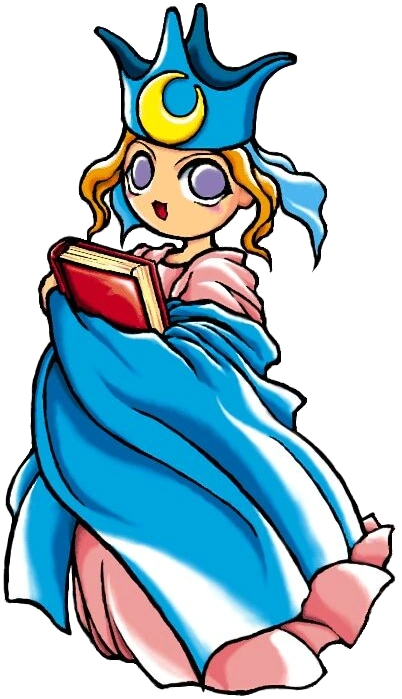
The sprite art, the various character themes, the character animations, and the voice lines do a lot to make every character stand out. Hell, you don’t even have to know an ounce of Japanese or even be literate to get a good feel and understanding of each character’s personality. One of the more subtle ways of storytelling I like is regarding a lot of the drop patterns. Like how Daughter Strength’s resembles a set of claws scratching down on your opponent’s board, representing her jungle-themed origins, or how Chariot and Justice’s patterns resemble swords striking down in the middle of the board, or how the World and Empress are frequently depicted as rivals and so the two have similar drop patterns, or how the Sun’s pattern resembles a knife used to slit the throats of her opposition, confirming my headcanon.

Another small detail that I like is how, in this version, in the middle of the board, there is text that reads “Me,” which refers to the player, and “You,” which refers to the AI player. If you’re playing with two players, it reads “Me” for both players, and in the demo mode, with two AI players playing against each other, both descriptors read “You.” However, if you’re playing as the Fool the text instead reads as “Didl” and “Dudl” for you and the AI, respectively. As Didl is one of the many cat noises he makes. Additionally, the text that displays in the middle also changes when you play as Tower, where regardless of if you’re Tower or the AI is Tower, the text in the middle will read as “Tower.”
Another aspect of the game that I really enjoy is its music. The menu music and stuff like that are very standard and basic, but the character themes go hard. Some of my personal favorites are I’m Mysterious, the Emperor’s theme, Daydream Travels Version 2, the High Priestess’ theme, and Challenger Version 2, the standard two-player mode battle theme. I’m The Best Version 2, the Empress’ theme, and Lonely Battle Version 2, the Magician’s theme also take honorable mentions.
Some of the criticism I have regarding the game’s presentation comes down to mainly the localization work, and I already discussed the issues with that previously. Another issue I have is how, in the One-Player mode, when you beat it and see the credits, for whatever reason, the music doesn’t start playing until like a minute in, so the names just appear in silence. In the Competition Mode, in that credits scene, the music finishes playing halfway through, then starts again from the beginning, which was common for a lot of CD-based games at the time, admittedly.

Apart from the aforementioned Arcade and Sega Saturn versions, there was also Magical Drop Pocket for the Neo Geo Pocket Color, which was loosely a poor man’s version of Magical Drop III. The game was developed by Sakata SAS and published by SNK and Data East in the latter part of 1999. The game doesn’t include an actual AI opponent that you compete with head-to-head, like the regular games do. Instead, the player attempts to fill a gauge by creating matches while looking at a picture of the opponent. And during the game, the AI can attack your board randomly.

Speaking of handhelds, there was also a version of this game released on the Game Boy Color, only in the US and Europe, and developed by Conspiracy Entertainment. This version only features The Fool, High Priestess, Emperor, Lovers, Chariot, Daughter Strength, Justice, and Star, and lacks a story mode. The only single-player mode is the survival mode.

After Magical Drop III, there were three other sequels: Magical Drop F, V, and VI, and unfortunately, none of these games are as fondly remembered as Magical Drop III. During the time MDIII was released, Data East was put against the fence quite a bit, with Magical Drop F being the final game they developed before flatlining altogether as a company in 2003.
Magical Drop F: A Grand Adventure Ain’t Easy! (マジカルドロップF 大冒険もラクじゃない! lit. Magical Drop F: Daibouken mo Rakujanai!) was released exclusively for the PSX in 1999, and is quite notable for its shift in art style. They ditched the cutesy chibi look of the previous games and went for a more realistic anime style that featured smaller eyes, more realistic proportions, and more detailed clothing.

It’s a bit hard to get used to the style at first, but over time, I started to really like it and enjoy some of the newer interpretations of the characters. Some characters had very minor design changes, like Justice, who only got a different outfit, or Empress, who virtually looks exactly the same; meanwhile, others look completely different, like Death, embracing the Grim Reaper design with large robes, or the Emperor, taking fashion advice from Dark Emperor Hardin.

As for new content, this game features a new item system, which allows each player to hold up to three items during a match, and these will have different effects on your board and opponent during a game. In addition, a lot of the special balloons in previous games were removed, aside from the Ice Balloons.
All the characters return in this game as playables except for Black Pierrot, who only appears in the game as a small cameo. The only new character is a guy named Burnz, who appears as a secret character who can be unlocked by completing Justice’s story campaign for a second time after defeating him once in the cave area.

One of the most notable aspects of Magical Drop F is its story campaign. Whereas Magical Drop III just had a board game, F has a full RPG-esque campaign that features Justice as your protagonist character. I haven’t played this mode myself, but from others, it seems to be a fun game mode that does a good job of fleshing out these characters and has a pretty entertaining story. However, from the screenshot below, you can probably imagine one issue that comes from engaging with said story…

This game was not translated, localized, fan-translated, or anything in any way, shape, or form; there aren’t even script translations on GameFAQs or anything like that. So, unless you can read Japanese, there isn’t much story to read.
Magical Drop V was the fifth game of the series and came out in November 2012. The game was released on Steam by a French indie development company known as Golgoth Studios. Console versions of this game were announced as well, but those were silently canceled.

This game featured yet another change in the art style, which is more in the style of a game like Puyo Puyo. The style is pretty hit or miss, though—personally, it’s my least favorite of all the other previous entries. It looks very mobile game-esque and even more stilted than the Magical Drop I sprites.
The game itself plays more similarly to Magical Drop III and removes the item system from F. It also removed a lot of the game modes, featuring only a single-player campaign and online multiplayer modes. However, the multiplayer modes did receive some new features, allowing you to play with or against three other players.

As for new characters, the new characters are Bruce, McCoy, and Mushman, characters from another puzzler game known as Ghostlop, and play using the mechanics from that game. Their method of gameplay is very similar to Bust-A-Move or Puzzle Bobble, but the two methods of gameplay don’t really mesh well in the same way Puyo Puyo and Tetris do.


In V, not every character who appeared in previous games shows up in this one. Lovers is missing, Judgement is missing, Hanged Man is missing, and High Priestess—who was in every game from the beginning—is also missing. What a rip-off!
This game also has a localization that’s on par with the PS1 version of MDIII and is probably even worse. Like using made-up ‘real names’ for the characters, which were headcanon names taken from users of the Fandom Wiki, like “Merrick the Hierophant” or “Tommy the Devil.” A lot of the character profiles are also majorly mistranslated, like The Empress’ profile stating that she works for Devil and Strength, when in actuality, it’s the other way around.
The game was also very buggy, having times when the music or graphics didn’t load properly, and other times the game would just outright crash. Though as shoddy as this game was, it was made by a very small indie company with zero budget while working on other projects. Golgoth was actually working on a much bigger game known as Toki, which had a lot of work put into it, but unfortunately, Golgoth went out of business before it could be finished, and the game was eventually finished and released by Microïds and Mr. Nutz Studio.
Eventually, though, in 2020, Magical Drop V was delisted from Steam, and can no longer be bought or played legally, which is really unfortunate. At most, you can only try out the demo, which is still up.

Lastly, in April of 2023, Magical Drop VI was released for PC and the Nintendo Switch and was developed by Highball Games and Storm Trident and published by Forever Entertainment.

Magical Drop VI contains the same game modes present in Magical Drop III with even the board game mode making a return. The game also features a lot of the same mechanics and features. It also features an online multiplayer mode like a lot of the other modern releases. This game features a new art style once again, and while some people don’t like it, I think it’s fine. They retain a lot of the same core elements and features as the MDIII designs, and while they are still a bit stilted, they’re a lot more lively and vibrant than V’s designs.

Like V, this game doesn’t feature a lot of the returning cast—for example, the High Priestess is missing again—but a lot of those fan-favorite characters are slated to return over the course of the next few years in the form of DLC, in a similar fashion as the Smash Bros’ Fighter Pass.

The whole “fighter pass” thing is a bit lame, like, I don’t really know why these characters aren’t in the game to begin with, but whatever. Hopefully, we’ll get the full roster in the game by the end of the decade.

Well, there we go; you brought up Magical Drop and got me yapping and yapping, and I just couldn’t stop talking, you only brought this upon yourself. And even then, I still have some more I could talk about, like Magical Drop Battle, or Ekoeko Magical Drop, or the 4komas I previously mentioned, or the weird Arcade Hits version, or Ghostlop… But I think that’s enough for now.
Magical Drop is just a really interesting and underrated series to me, and its third entry was what got me to realize how interesting the puzzler genre could be. Through reading this, I hope you enjoyed my little review and learned something about the true meaning of friendship. In any case, feel free to read some of my other reviews or check out my drawings on Ko-Fi. See you again soon!
