Physical Address
304 North Cardinal St.
Dorchester Center, MA 02124
Physical Address
304 North Cardinal St.
Dorchester Center, MA 02124

Hello everybody, Happy New Year! Are you having a good year so far? I hope you’re having a shit one, because today I have a new blog post coming at you like an arrow. In this post, I’m going to be discussing another Sega Saturn game, but not only that, but yet another Working Designs game!
Magic Knight Rayearth is actually a game I played quite a long time ago, around the same time I played Exile for the first time. It’s a game I’ve wanted to talk about because, between the stuff regarding its backstory as a manga, the collab with CLAMP and Sega, and the development hell Working Designs went through when bringing the game to the West, there are a lot of cool details about the game that I find interesting to discuss. However, the reason I’m writing about the game now, and I didn’t back then, was because I didn’t want my blog just to be “The Working Designs Fan-Blog.” I want to talk about other games too, lol.
I had the topic for this blog post on the back burner for a while until a few days ago, when I was talking to someone on Discord, and they mentioned this game when talking about 2D Sega Saturn games. At that moment, I decided that instead of doing what I normally do and spending the next hour lore dumping about the aforementioned cool details that no one in the server would care about, let alone read, I’m going to make a blog post where I talk about the game. So if the game ever comes up again, I’ll just link this page. They probably still won’t read it… But at least it’s out of my system.
Anyways, let’s stop wasting time and let’s start dancing to the tune of the Sega Saturn’s swan song: Magic Knight Rayearth!

Magic Knight Rayearth is a game that is classified under the ARPG sub-umbrella, but the A in this case stands for “anime” and not “action.” …Well, the Saturn game is also considered an Action-RPG, but that’s not too relevant for this section. The Anime RPG subgenre is one that was starting to bloom back in the early 90s with titles such as Cosmic Fantasy, Tenshi no Uta, and Emerald Dragon. Additionally, games in this classification didn’t always have to be RPGs, considering games like Valis and Popful Mail were often put in the same category.
That said, Magic Knight Rayearth stands out from its contemporaries, as it was based on an existing manga series, rather than being an original IP. Something that people may not know is that the anime was backed by Sega themselves, and this wasn’t even the first time Sega had backed an anime. In the 1980s, Sega worked directly with animation studios such as Tatsunoko Productions to work on Red Photon Zillion (赤い光弾ジリオン lit. Akai Kōdan Jirion), Ashi Productions to work on Sonic Soldier Borgman (超音戦士ボーグマン lit. Chōon Senshi Bōguman), and Fuji TV to work on Magical Hat (まじかるハット lit. Majikaru Hatto). In the case of these shows, Sega had some creative say in what was included in these series; the most notable example is Opa Opa, from Sega’s Fantasy Zone series, appearing in Zillion.

Additionally, Sega had exclusive rights to toys or other merchandise that were produced for specific shows. This merch consisted of action figures, interactive laser-tag-esque games, and toy guns. An interesting note is that it was rumored that the Zillion toy gun was rebranded as the Master System Light Phaser in the US; however, this is not actually true. The Zillion anime debuted in April of 1987, which was a few months after the peripheral was released in the US. So it’s more likely that the Zillion gun was actually based on the Light Phaser, as some kind of reference, like the aforementioned Opa Opa appearing in the anime.
Aside from toys, Sega would release the tie-in games Zillion, Zillion II, and Borgman for the Sega Master System. As well as Magical Hat for the Mega Drive, which was reworked in the US as Decap Attack for the Sega Genesis.

These collabs and tie-ins were actually a part of a common business strategy called Media Mix (メディアミックス lit. Mediamikkusu), in which a piece of media is dispersed amongst several different formats (i.e., games, anime, manga, toys, tokusatsu, etc.). For example, with the Pokémon series, it was released as a game, anime, manga, and trading card game. It’s a strategy that gained notoriety in the 1980s, but can be traced back to as early as the 1960s. While I won’t get into it here, the book Anime’s Media Mix: Franchising Toys and Characters in Japan, by Marc Steinberg, does a good job at going deep into this strategy and explains the evolution of it.
However, aside from these three games, Sega mostly stopped doing Media Mixes. This was for three main reasons: One, they were very expensive to produce, specifically with anime series; it was much cheaper to buy the license of an existing series than to back the creation of an original one. Two, Sega’s own IPs were already doing well; series like Sonic the Hedgehog or Streets of Rage did better than the Media Mix series, and relied on much less to produce. And three, the technology at the time made it hard for Sega to depict what happened in the show, which, I mean, makes sense. It’s like trying to turn the events of Chainsaw Man into an Atari game.
However, something changed in the 90s, Sega acquired Yonezawa Toys (now known as Sega Fave) and Tokyo Movie Shinsha (TMS Entertainment). And with those two acquisitions, this made Sega the largest toy manufacturer in Japan, as well as owning the company behind series such as Lupin the Third, Aim for the Ace, The Rose of Versailles, and Detective Conan.
Furthermore, with the release of the Sega Saturn in 1994, they were capable of actual full-screen FMVs and more concise gameplay, which provided more potential for a more interactive anime experience than the likes of Zillion on the Sega Master System. When the Sega Saturn was unveiled at the Tokyo Game Show ‘94, among the upcoming Saturn games that were announced was Magic Knight Rayearth, and not only that, it was also announced that an upcoming anime series would come out for the game.

The game didn’t just spawn out of thin air, though; the game, as well as the anime, was based on the manga series of the same name. The original manga was a Shoujo manga which featured elements of isekai, mecha, and swords & sorcery. It first appeared in 1993 in the manga magazine Nakayoshi, published by Kodansha and written by CLAMP.
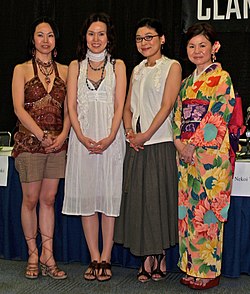
CLAMP is an all-female mangaka group currently consisting of four core members: Nanase Ohkawa, Mokona Apapa, Tsubaki Nekoi, and Satsuki Igarashi. It’s kinda like the shoujo version of The Beatles… you can decide which Beatles member coincides with which CLAMP member. Anyways, when it was first founded in 1980, it was a doujinshi group which consisted of 11 people, but seven of those people have left… if you couldn’t do the math yourself. Despite their focus on shoujo manga, their works are very popular, not just in Japan, but worldwide, with series such as Cardcaptor Sakura, xxxHOLiC, Clover, and Chobits. They even did Miyuki-chan in Wonderland, which I briefly mentioned in a previous article. (wink-wink, nudge-nudge)
Before Rayearth, CLAMP had done illustrations for Yoshiki Tanaka’s novel series, Sohryuden: Legend of the Dragon Kings. During the celebration of the novels being published, the group was asked by Hideki Yamaguchi of Nakayoshi to make a series for their magazine, one that would appeal to younger readers. Without much direction, the group decided to work on a manga series that combined mecha (as the group was a fan of mecha anime at the time), RPGs, which were exploding in popularity in Japan at the time, and fantasy to counterbalance the mecha aesthetic, out of fear that the mecha aspect alone would alienate people.

From this, the result was a manga featuring three young girls named Hikaru Shidou, Umi Ryuuzaki, and Fuu Hououji. They come from three different schools, and those three schools happen to all be on a field trip to Tokyo Tower at the same time. During this field trip, the three of them hear a voice calling to them, and they are isekai’d to the world of Cephiro.

After falling from a thousand feet in the air and being perfectly fine, they reach Cephiro. In Cephiro, they meet the Master Mage Clef, a wise sorcerer who gives the protagonists advice throughout their journey. He explains to the girls that the Princess of Cephiro, Princess Emeraude, was captured by the evil sorcerer Zagato, and the princess was the one who had called them to rescue her. He also explains that the three heroines are the destined Magic Knights who are fated to save Cephiro by reawakening the Rune Gods: Selece, Windam, and the eponymous Rayearth. The three Rune Gods correspond to the elements that the three Magic Knights represent: Hikaru (光), being Japanese for light (which refers to fire); Umi (海), being Japanese for sea; and Fuu (風), being Japanese for wind.

Shortly after meeting Clef, they run into Alcyone, a very attractive sorceress who works under Zagato. Alcyone starts attacking the girls, and Clef is turned to stone by Zagato. Hikaru is able to fend Alcyone off with a magical fire attack and get away. After defeating Alcyone, they make it to the Forest of Silence, where they meet the blacksmith Presea, who agrees to make special weapons for them, and the cute mascot character Mokona, who helps guide the girls on their adventure.
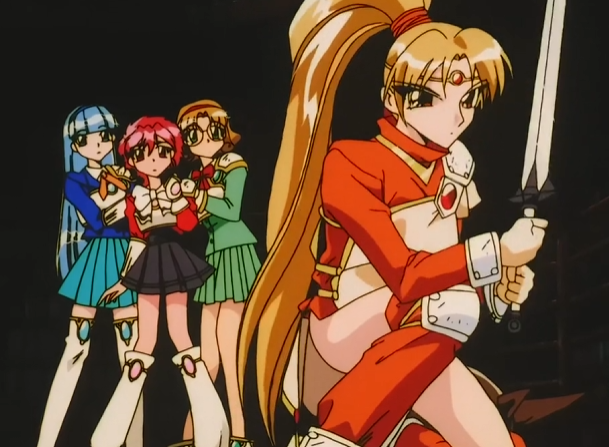

From here, the girls go off on their adventure, finding new allies and new enemies, discovering new areas, and learn more about the world of Cephiro as well as more about each other. Like always, I’m not going to give a play-by-play of the story because it’s best experienced first-hand. That said, though, while the main plot structure is the same between the manga, anime, and Saturn game, each version contains different events, different story beats, and even some different minor characters, which makes it worth it to check out every version of the story. And that’s not a recommendation, it is a command!
Moving on to the Sega Saturn, the game was directed by Rieko Kodama, who is known as one of the first successful women in the video game industry. She spearheaded several other Sega projects (which were mostly RPGs), such as Phantasy Star, 7th Dragon, and Skies of Arcadia. In fact, a lot of the dev team were coming straight from Phantasy Star 4, such as Yasushi Yamaguchi and Akinori Nishiyama.
As you’d expect, Sega worked very closely with TMS to preserve the same look and style of the series, with many of the same animators working on both the anime and the in-game cutscenes, such as Atsuko Ishida.
While the Japanese development of the game was fairly straightforward, with development starting in 1994 and releasing early in the Saturn’s life in 1995, this was NOT the case for the US version. The game was picked up by our good friends, Working Designs, and they had planned to localize the game into English. The English version was initially slated to release in June of 1996, but a number of blunders, quagmires, and a series of misfortunate events resulted in the game being delayed all the way to December 1998, long after the Saturn was already dead and buried in the US.

This made the game the very last officially released Sega Saturn game in the US, and is a big factor as to why the game is so ungodly expensive to buy nowadays. But how did that happen? It’s a long story.
In a 1996 interview with Working Designs, they mentioned that Magic Knight Rayearth was the biggest project the company had to undertake, and referred to the localization process of the game as an overall “terrible experience.”

With a lot of the games localized by WD, in order to get the license, they would just buy the rights from that game’s parent company, then get to work. For Rayearth, though, they not only had to get the rights from Sega of Japan, but also CLAMP and Kodansha, which extended development time.
After the licenses were bought, as the company does, they went through the game’s code in order to get to work. However, a big chunk of the game’s source code was missing; they repeatedly asked Sega of Japan for it, but it turns out it was destroyed in a hard drive crash, and there were no backups.
Because of this, the company had to rebuild the game’s code by pulling binaries out of libraries on the production discs. And being a smaller publishing company, rather than a big game development company, this unsurprisingly took a lot of time. In fact, it took about a year.
Additionally, the status of the Sega Saturn itself did not help in the release of the game in the US. Working Designs’ initially positive relationship with Sega soured when Bernie Stolar left Sony and became the new C.O.O. of Sega of America in 1997. Stolar was notable for having very bad taste in games, as he hated 2D graphics, RPGs, or Japanese-themed games, which was essentially WD’s entire library… He was also rather infamous for his declaration that “The Saturn is not Sega’s future,” which effectively took this already dying console, and injected 100g of cyanide capsules into its bloodstream. Stolar was a big thorn in the side of Working Designs, according to Vic, and made it so that releasing any JRPG in the US under him was nearly impossible.
This soured relationship with Sega caused WDs to not localize games for the Saturn anymore, and they moved to the PS1. For instance, the localization for Lunar: The Silver Star Story for the Sega Saturn was cancelled, and they opted to localize the PS1 version, Lunar: The Silver Star Story Complete, instead. That said, in the long run, this was kind of a good thing for WD, since the PS1 was so popular, it further got the publishing company’s name out. That said, they only continued working on Rayearth after that because they had promised their fans that it would be completed, and they were still permitted to release it.
Furthermore, the anime and manga were being prepared for an English localization, and Working Designs was given a design document with all the name changes and stuff in order to have the game match the anime. However, this was after most of the voice acting was already recorded and everything, and they didn’t want to rerecord everything.
In a 2024 interview with Victor Ireland in the Retro Hangover Podcast, he mentions that in this document, they wanted to change the main girl’s names, and specifically brings up Umi, which they wanted to rename to Anemone, “like a sea anemone,” however, he likely meant Fuu, as Anemone is also Greek for “daughter of the wind.”
The anime localization he was referring to was most likely the unreleased Ocean dub, directed by Sarah-Anne Dafoe, and was only a test pilot at the time. This same dub had Hikaru named “Luce,” and Umi named “Marine,” which, honestly, are fine names; at least they retain the meanings behind the original names, which is something that wasn’t as common in American localizations at the time. I mostly just prefer Hikaru, Umi, and Fuu because the girls are supposed to be Japanese, so the original names work fine. Though their hometown would likely have also been changed to California or something to make the name changes make sense, a la Ace Attorney. Apparently, these name changes were mandated by TMS and were used in dubs for other languages.
This dub also featured a new opening, which was found on TMS’ licensing sites. The pilot was reportedly screened at FanimeCon 1996, and other cons at the time, and allegedly wasn’t well-received. But beyond these alleged screenings, the existence of this pilot is still unconfirmed, and beyond the opening and promos, it’s still mostly lost media.
Aside from that, Vic couldn’t obtain the rights to use the Japanese OP for the game, so English lyrics for the song were written by Vic and sung by the talented Jennifer Stigile. Furthermore, like most WD games, all the voice work is done by WD employees, so none of the characters retain the same English voices they have in the later Media Blasters English dub.
One of the most jarring voices is Hikaru’s; she has the same VA as Mail from Popful Mail, Melissa Gulden, and the two roles have the actress speaking in the exact same tone and cadence, so hearing Mail talking about reawakening the Rune God Rayearth and saving Cephiro always took me aback. It’s just like when I watched the Higurashi anime for the first time, and being taken aback every time Keiichi spoke, because he has the same exact voice as Leon Kuwata/Shuichi Saihara.
Oddly enough, even though the characters’ voices were dubbed in dialogue and FMVs, the girls’ chants when they use magical attacks are still in Japanese. What’s up with that?
Many character or location names, while retaining their Japanese names, would use alternative romanizations or spellings than the official ones. Most of the notable ones are shown below.
| Official name | Working Design name |
| Emeraude | Emerald |
| Presea | Precia |
| Rafaga | Rafarga |
| Zagato | Zagat |
| Cephiro | Cefiro |
| Alcyone | Alcione |
| Mashin (the Rune Gods) | Machines |
| Hikari (Hikaru’s dog) | Flash |
Also, fun fact, something I only learned while doing research, was the fact that the citizens of Cephiro are all named after cars. For example, the Mazda Clef or the Nissan Presea. Apparently, this was done to help young kids who weren’t totally familiar with katakana yet. They’d see names they’d already recognize from commercials and stuff, so they could put two and two together. The names also already fit in a fantasy setting.
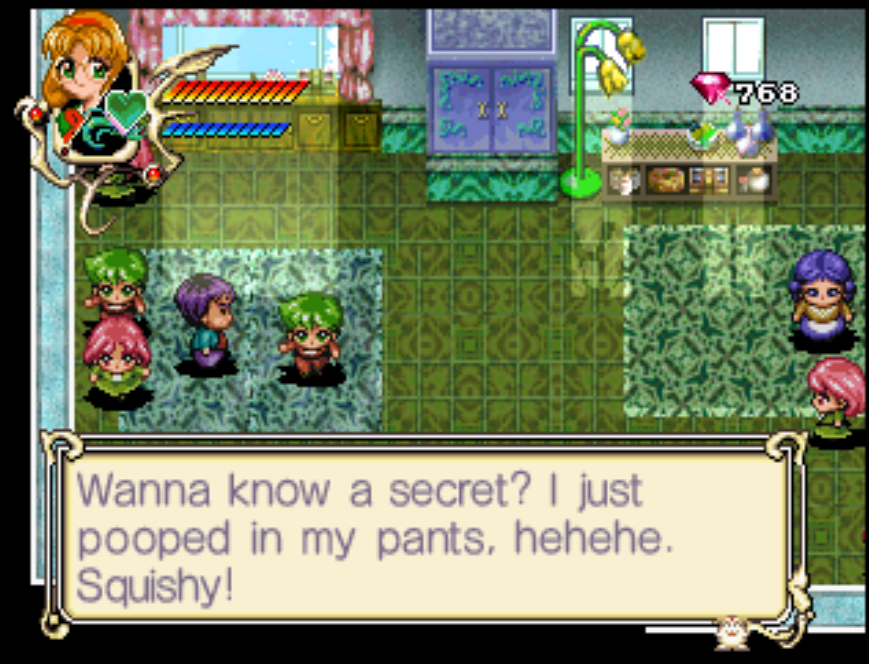
As for more in-depth localization changes, like WD’s other works, they punched up the dialogue a lot, adding in jokes or pop culture references. If you’ve read my Popful Mail, Exile, or Cosmic Fantasy 2 articles, you already know their brand of humor.

Something particularly funny about this game is that it’s usually the game most people share screenshots of when they want to discuss how bad WD’s localization changes are. This one, and a particular screenshot from Alundra, are ones I’ve seen shared a lot in forum posts and YouTube videos.


Hell, Victor Ireland himself also mentions in the aforementioned Retro Hangover Podcast that some of the lines in that game were a bit too out of pocket, and even referred to them as “cringe.”

There were also cases of people in the 90s and 2000s calling and complaining to Working Designs because of a line Zagato has early on, because, in a convo he has with Alcyone, he describes fighting against the three Magic Knights as “child abuse,” which got some parents upset. Which, I don’t know why, but I feel that would be unheard of nowadays concerning that particular subject.
While I personally find a lot of the dialogue hilarious, it’s more of a question of whether or not it fits the setting or how different it is compared to the Japanese version. I remember a friend of mine who’s more familiar with the anime mentioned that the dialogue is very OoC for the anime.
Aside from that, they increased the stats of many of the enemies in the game, which is mostly notable with bosses, as they’d move on the map faster, do more damage, and take more hits to kill. While there are some spikes in difficulty with some bosses, I never found the game overly difficult or anything, and overall, the game is still pretty easy. Like Popful Mail, there’s an Un-Worked Designs patch which reverts the enemy stats to what they were in the Japanese version, but since the WD script is still intact and the game isn’t made too much harder by WD, the Un-Worked patch is a bit unnecessary.
Beyond that, in Japanese, every NPC that had a portrait had voiced dialogue, which is removed in the English version, outside of very major characters. Since you couldn’t advance the text until a character is finished speaking, this change ends up speeding up the pace of the game, especially if you’re someone who goes back to older locations to look for any new dialogue.
In the manual, they mention that with the extra space that was freed up from removing those voices, they were able to have the Review Trip entries that the girls have feature voice-overs, which makes them feel a bit more personable.

That said, this isn’t actually fully true, as if you look in the game’s files, the Japanese voices for the NPCs are still on the game disc; they are just unused.
Other changes include the fact that a few portraits have extra animations that were removed in the US version, likely due to a combination of difficulty generating lip flaps and the fact that these animations are very seldom used. For example, Hikaru has an arm-raising animation that’s used exactly once during the intro sequence.

There are also a handful of instances where one character’s portrait was swapped for another character’s. I’m not sure why, but it kinda reminds me of something similar in the Project Exile patch for FE5. With that, I’m inclined to believe it was because they had a similar method of programming dialogue, as well as something to do with the code being rebuilt. For example, in the dialogue shown the first time the island in Lekuido is moved, Hikaru’s shocked portrait is replaced with Umi’s.
Additionally, FMVs are skippable with the Start button in English when they aren’t in Japanese. The number of save slots was increased from three to six. An outtakes option was added, which allows you to listen to a blooper reel as a reward for collecting all the Rainbow Amulets. And lastly, the game’s manual mentions that “sprite consolidation and reduction” was performed on the game in the US version in order to reduce lag, but uh… no one really knows what that means.
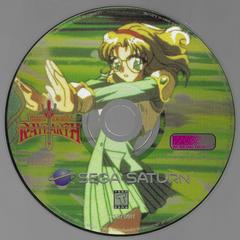
Beyond that, like a lot of the games they published, Working Designs would always do the most when it came to packaging. It wasn’t as flashy as the stuff they did for Lunar, but it was definitely some cool shit. Specifically, the game was able to come on one of three different discs: one featuring art of Hikaru, one featuring art of Umi, and one featuring art of Fuu. You didn’t know which disc you’d get before opening the box, so it was kinda like a little gacha thing. This was probably hell for collectors.



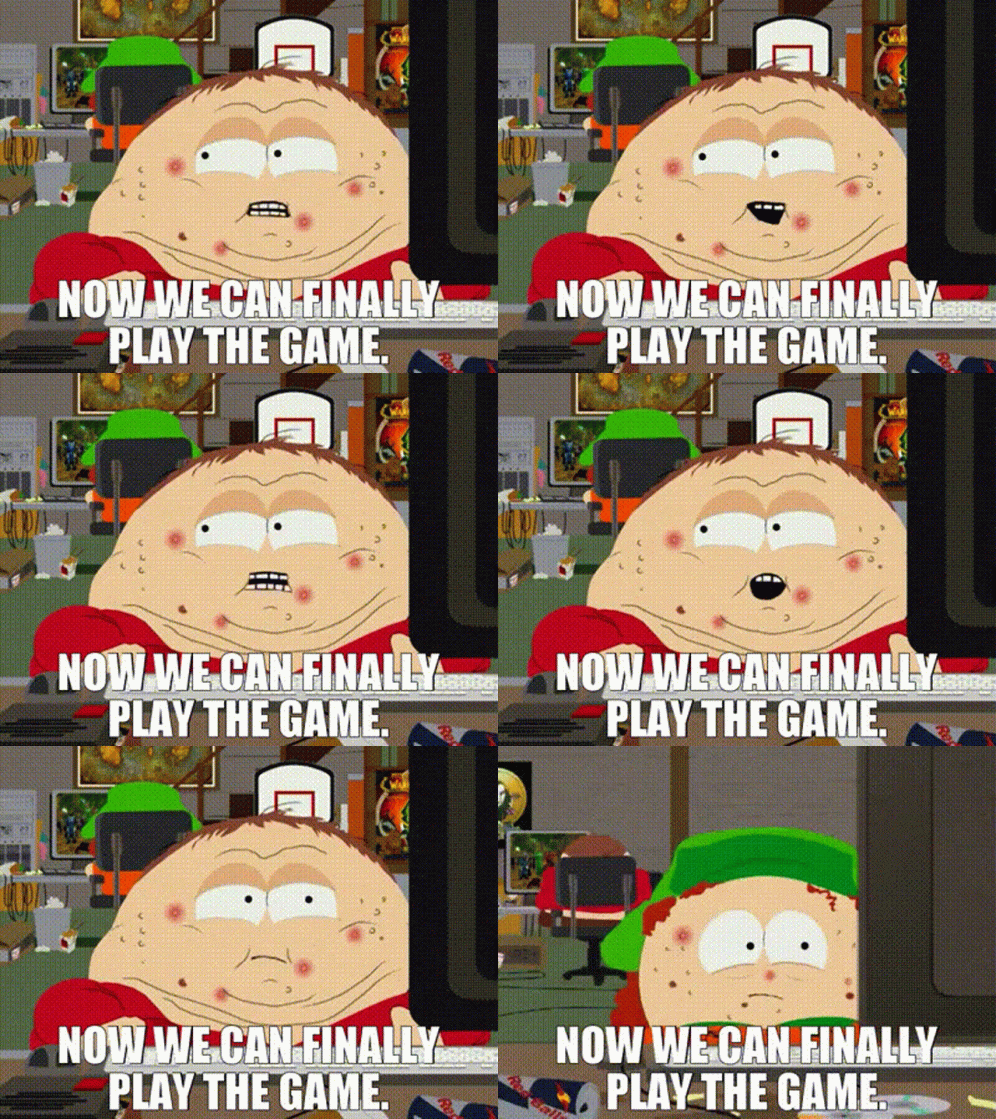
Magic Knight Rayearth presents itself as a top-down Action-RPG similar to the likes of A Link to the Past, Secret of Mana, Terranigma, or any other similar game of your choice. That said, like Popful Mail, it’s kind of hard to refer to this game as an RPG at all, despite what it says on the box.
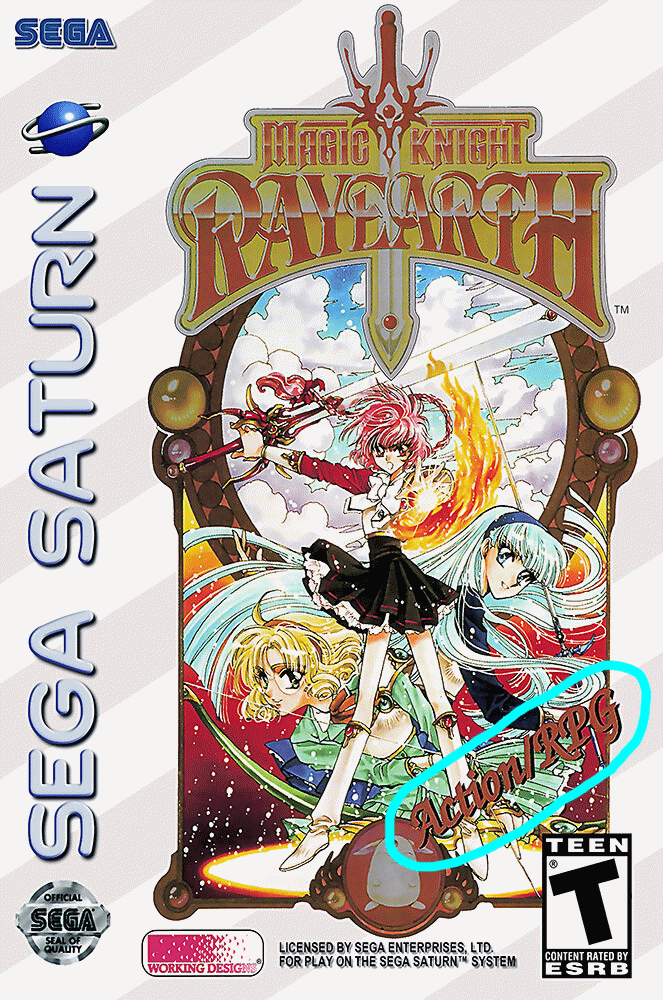
The game doesn’t have a traditional leveling system, an EXP system, or anything like that. When you defeat enemies, all you really get is money and sometimes items that restore HP or MP. Levels are typically gained through story events, and the only type of influence you have is through Max HP or MP increase items that can be found hidden in various stages. This makes it so the difficulty can be easily balanced from a developer’s viewpoint, as the player can never be too over- or underleveled.
But I feel I’m getting a bit ahead of myself, so let me explain the basics. During the game, you can control either Hikaru, Umi, or Fuu. You control one at a time, while the other two follow you around. You can press A to attack, talk to people, and interact with objects; B to jump; and X to run when you obtain the running skill.
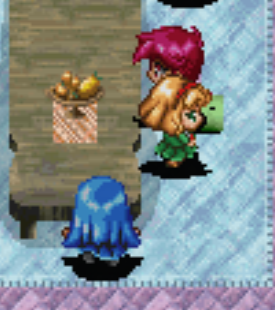
Additionally, you can switch between each girl using the L or R button. Hikaru can attack with a Shinai (a type of sword used in Kendo), Umi can attack with a Foil (a type of practice sword used in fencing), and Fuu can attack with a bow and arrow, which naturally makes Fuu the best of the three. Like, it’s honestly kind of ridiculous how broken Fuu is, especially when she gets her lock-on ability. I do like how the weapons they use relate to their personal lives, like Umi being in a fencing club at school and preparing for a fencing tournament for when she goes back to Japan, and Umi being a member of her school’s archery club.
Over the course of the game, each girl also gets magic attacks, which can be used by the C button, and swapped using the Z button. And as if Fuu wasn’t good enough already, she’s also the only one of the three that gets healing magic, in addition to attacking magic. Their magic attacks aren’t used strictly for attacking, but also for puzzles in the game’s various dungeons. A big aspect of the game is dungeon crawling and solving puzzles, and they’re designed pretty well for the most part.
That said, though, I do have one big criticism of the game. The girls have their own health bars, so when one dies, you switch to the next one, and the dead one is unusable until you revive them. Since the game doesn’t have any restoratives you can carry on hand (unless I missed something), if Umi dies, for example, and you need her to solve a specific puzzle late in the dungeon, you simply cannot progress.
Your only options are to kill Hikaru and Fuu so you can get a game over and reload from your last save, or just reset your game. It’s kind of obnoxious, especially considering how big some of the later dungeons can be, and I kinda wish the game were like Popful Mail, where you just got a game over if one of your party members died.
In the pause menu, which is accessed by hitting Start, you can view your character’s HP/MP, view their Escudo Level, which takes the place of your level in a traditional RPG game, which only increases through story events, as I mentioned earlier. The higher your Escudo level, the more damage you do to enemies. You can also view your magic and a brief description, as well as the skills you’ve learned. And lastly, you have the command window, which has its own menu.

This window has the Illustrated Diary, which just lets you save the game. Then, there’s the Review Trip Memories, which are journal entries telling you about the important events in the game. As I mentioned before, these are narrated by each of the girls, and it’s pretty cool because each girl has their own unique entries, so you can glean aspects about each of their perspectives through these entries. They’re also pretty handy in case you haven’t played the game in a while; it can remind you of what happened last, and what you need to do now.
Then there’s the Item menu, which lets you view the items you have. You can view key items/restoratives, the machines you have revived currently, or the number of rainbow amulets you have.
When researching the game’s items through the manual again for this blog post, though, this is where I learned that there is an item that can be used to revive characters after they’ve died, which I apparently missed. So my previous criticism was complete bullshit, and I made the game harder for myself for no reason. Sigh…

The command menu also has an option that allows you to consult Clef, where he gives you some sage advice on what to do to progress in the game. I never really used this much, though.
Lastly, there’s the settings option, where you can change the game’s text speed. You can also determine how the sound in the game is heard: Stereo (which the manual describes as girl power) or Mono (which is described as no power). And lastly, you can reconfigure the control scheme.

At the end of dungeons, you fight a boss, and as I mentioned before, they are buffed compared to the Japanese version. While, for the most part, they aren’t too bad, one particular boss in the midgame particularly pissed me off, to the point where I considered dropping the game. Even after I beat it, I was concerned whether or not I’d be able to beat the rest of the game. Luckily, none of the later bosses were as difficult.
In the Inferno Mansion, you encounter Alcyone, and rather than fighting you herself, she sends fire monsters to attack you. I’ll provide a video of this fight below, but it’s a headache.
It may be hard to see how difficult this fight can be by watching it alone, so let me paint a picture for you. Imagine you were playing the original Pac-Man for arcades, but instead of collecting all the pellets, your objective was to kill all four of the ghosts. Now imagine that all the ghosts require like 12 hits to kill, but you still die in a single hit, and your attack options are sword, longer sword, and bow.
Doesn’t sound too hard, huh? Well, now imagine that while you’re stuck traveling and maneuvering the maze, the ghosts have free movement, and can pass through walls and shit. On top of that, the ghosts have a long-range grapple attack that can extend from across the map, beyond what you can see on the screen. If that still doesn’t sound hard, well then, fuck you.
At the end of the game, after reviving the Rune Gods, the last portion of the game becomes a top-down vertical shooter, which is kinda cool. You know, if I had a nickel for every time an Action RPG game I’ve played shifted to a shooter in its final act, I’d have two nickels, which isn’t a lot, but it’s funny that it’s happened twice. My criticism of that portion of the game is similar to my criticisms of the Xak version; It’s quite hard, and you will die a lot. However, it is nowhere near as obnoxious as the one in Xak. Magic Knight Rayearth’s final bosses did provide some semblance of fun, which is more than I can say for the fucking Salamander boss in Xak.
I guess one thing that’s neat about the boss, and most bosses, is that when you die, get a game over, and re-enter a boss battle, the boss will typically have unique dialogue pointing out how you’re back again to challenge them.
It’s really charming, and one big upside to the game is the charm. It’s one of the few RPGs where I actively enjoy talking to NPCs and hearing what they have to say. Granted, a lot of the humor is added by the localization, but the stuff that is unchanged from the original is still quite good.

The three heroines are really great, and I love how the three of them bounce off one another really well. Hikaru is the energetic and cheerful one, Umi is the more outspoken and arrogant one, and Fuu is the more levelheaded and blunt one. Each girl has their own strengths and flaws, and have their own unique arcs and challenges that they overcome over the course of the story.
My favorite of the three is probably Hikaru, as basic as that sounds. Her upbeat demeanor, altruistic personality, and sense of justice are really infectious and always inspire me to be a better person, and is a nice breath of air compared to the protagonists that mostly focus on the badass fighter route.
The part that made me really love her as a character takes place pretty early on in the game. You reach a village that’s being lorded over by a bunch of monsters, and an old wizard dude named Leukino is extolled by the people as the protector of the village who will stop the monsters. However, this time the monsters are too strong, which causes Leukino to feel insecure about his abilities.
When the magic knights appear, they go to the dungeon to handle the monster problem, and Leukino, who feels threatened by Hikaru, Umi, and Fuu, tries to get in their way throughout the dungeon. He is unsuccessful and ends up getting kidnapped by the boss, so the knights have to rescue him.
After you save him, he apologizes for his actions and returns to the village with you. Once they reach the village, the villagers all congratulate the girls for stopping the monsters, only for Hikaru to say, “Oh, it was actually the village protector, Leukino, who stopped the monsters. By the time we reached him, all the monsters were already tamed.” This causes a lot of the villagers to renew their respect towards him.
Leukino is exceedingly grateful towards Hikaru, and it honestly hits me in the feels. Umi and Fuu question Hikaru on whether or not it’s a good idea to let him off scot-free, let alone giving him all the credit. Hikaru responds saying that they won’t gain anything from telling the truth, and now he and the villagers are happy, so the only one who could judge or guilt Leukino is himself. Essentially, leaving things up to him if he ever wants to fess up or not.
Later on, you can revisit the town, and it seems he did eventually tell the people the truth, but they still respect him enough as the village protector, and he’s regained a lot of his confidence.
Even a lot of the NPCs and villains have strong, memorable personalities, and their own character arcs and plotlines. I particularly loved Ascot and Caldina, and found their arcs constantly leaving me on the edge of my seat. But I won’t tell you what happens with them, that’s a spoiler, so you need to play the game yourself. Hah hah!
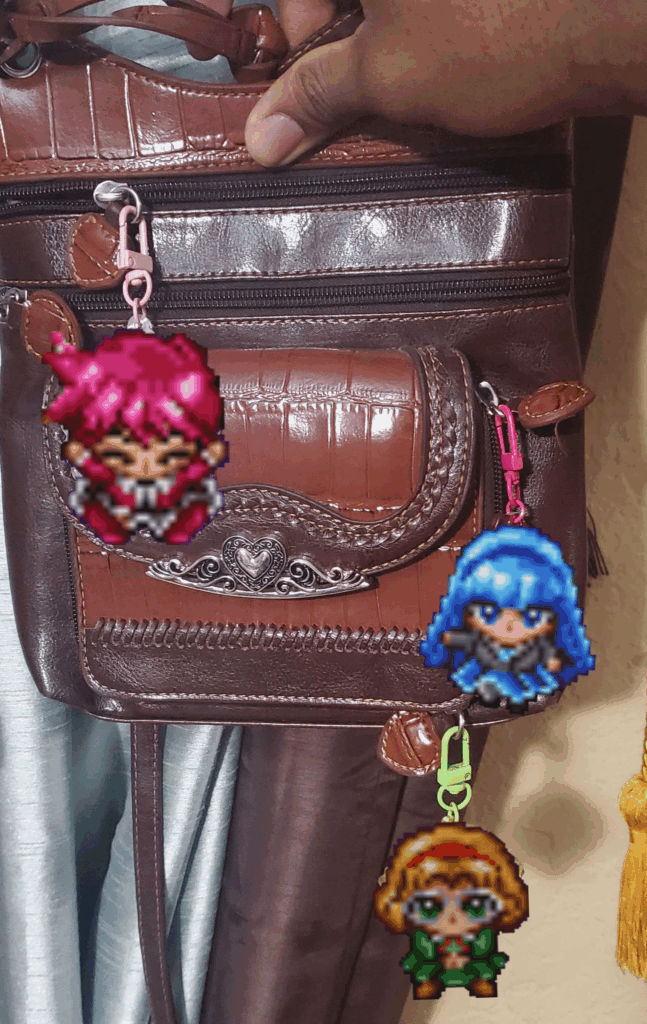
Beyond that, the graphics are great, stunning even. It’s the first game that I point to when I tell people that 2D >>> 3D, at least in terms of the Sega Saturn’s library. Beyond just looking good, the little chibi character sprites are downright adorable. From their jumping sprites to their running animations, they make me want to attach them to my purse as if they were collectible Labubus.
The stages are also really beautiful, especially the outdoor-themed dungeons. My favorite in particular was the Sky Garden, which reminded me a lot of Cloudy Court Galaxy. The music provided a nice, serene atmosphere, and the scenery was therapeutic.
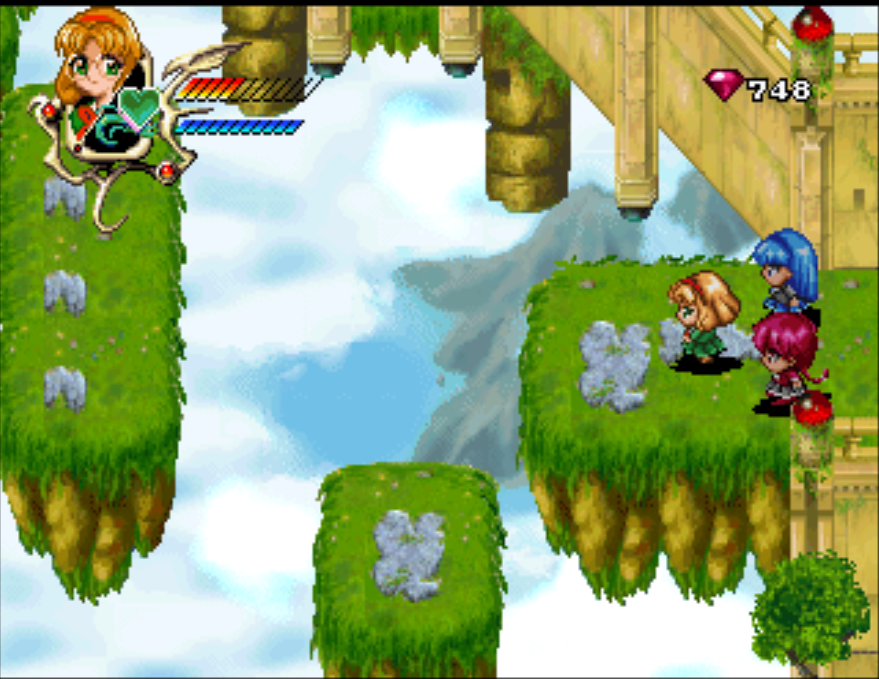
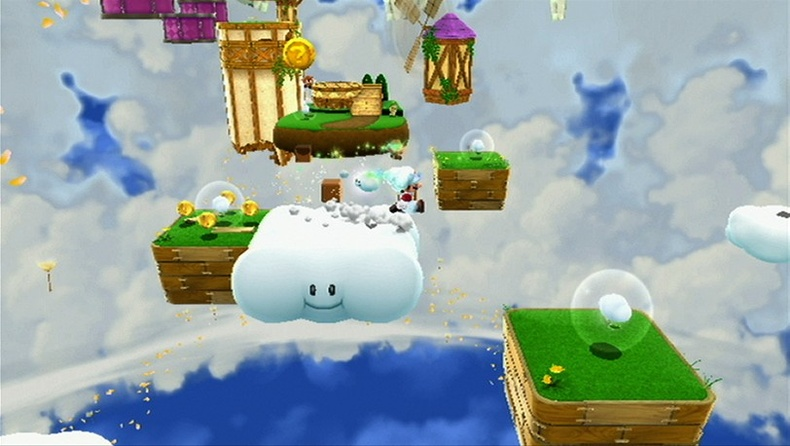
Overall, though, most of the music didn’t stand out to me too much, not that the OST is bad or anything, it just didn’t tickle my ears as much as something more fast-paced and upbeat like Exile, for example. My favorite song was probably the minor boss theme, but that’s definitely more of a factor of personal music preferences than an actual criticism.
The voice acting was also just okay, like most games published by this company. While I loved the opening and ending songs, everything else was mostly middle-of-the-road. If you played any other WD game, you’ve heard all these same voices before. Something that’s a bit funny is that since the anime didn’t get a full official dub until 1999, these were the first ever voices the West heard these characters with. That kinda makes me wonder if there were people who grew up in the 90s, who associate Hikaru more with Melissa Gulden than they do Julie Maddalena.
Beyond the game itself, there are also two prototypes for the English localization that were documented on hiddenpalace.org. The more interesting of the two is dated September 16th, 1997. This version contained a different opening FMV, featuring a different take on the English opening. This version features sound effects that aren’t in the final version, as well as the FMV being ripped straight from an episode of the anime, likely as a placeholder until they could get a version without text.
The Japanese voices are mostly intact, outside of the intro. Some grammatical and text differences are different, and by the time you reach the Tree of Life, Lairy, most of the NPC dialogue is completely untranslated. Not that you’d see much of it, because defeating the Tree of Life boss softlocks the game.
Enemies still have their statlines from the original Japanese version. There are only three save slots, while the final game increases it to six. And the title screen is different, being labeled as simply “Rayearth” rather than “Magic Knight Rayearth,” and the logo design resembles the Japanese logo, with the sword being horizontal rather than vertical and the font looking very similar to the Japanese one.


The other prototype was dated October 8th, 1998, and was mostly just a review copy. From what I see, nothing about this version is much different from the final revision, which makes sense, as it was only a month before the final US build.
Besides the Saturn game, prior to its release, Sega had released a Rayearth game for the Game Gear in December of 1994, simply called Magic Knight Rayearth. It was a short and simple turn-based RPG based on the anime, and follows an alternative storyline where Mokona runs off, and the girls have to find them. While the game was only released in Japan, it got an English fan translation in 2018 by Supper, who did the hacking, and filler, who did the translation.
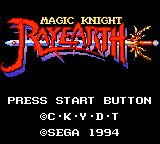


When this game was released, it also came with a limited edition bright red Rayearth-themed Game Gear system. The game was packaged with the system, as well as sold separately.
Then, a Game Gear raising simulation game, Magic Knight Rayearth 2: Making of the Magic Knight, was released in August of 1995. In June of 2014, an unfinished English fan translation was released with translations by Kiiri and everything else done by Pearse Hillock.


There was also Magic Knight Rayearth: Tanjou for the Sega Pico, a game aimed at much younger children, which featured minigames and quizzes.

There were also Rayearth games on non-Sega systems. One RPG on the Super Famicom called Magic Knight Rayearth, and two RPGs on the Game Boy called Magic Knight Rayearth and Magic Knight Rayearth 2nd: The Missing Colors. The Game Boy games were both developed by Pandora Box and published by Tomy. The SFC one is just credited to Tomy. While Sega had exclusive rights to release Rayearth games on their consoles, those rights only extended to games based on the anime. So these games on Nintendo’s systems were heavily based on the manga.
The SFC game had an English fan translation released in March of 1999 by LNF Translations and RPGe. And fun fact, it was the second SFC RPG to ever get a fan translation, the first being Final Fantasy V. fantasyanime actually has a really good article based on this fan translation, which I highly recommend checking out. I’ll link it in the references section of this post.
This patch eventually got an addendum patch in October of 2022, by mteam, consisting of mziab, blip, ffgriever, and FlamePurge. This aimed to improve the experience by implementing VWF for dialogue text, a dual-line hack for items and spells, replacing the menu font with a Chicago variant, translating the title screen logo, an optional patch to reduce the grind, and, of course, retranslating the script.


The first Game Boy game received a fan translation in 2023 by LIPEMCO! Translations, which consisted of TheMajinZenki, Supper, and cccmar.


The 2nd Game Boy game was released in July of 2014, and translated by Pearse Hillock and Kiiri, once again.


On the topic of games, the series is also featured in 2019’s Super Robot Wars T, as well as 2021’s Super Robot Wars 30. That’s actually where I first started to garner interest in the series.
As for anime, a second season was released in 1995 called Magic Knight Rayearth II. It ran for 29 episodes and featured new characters, a new story, and a different tone. After that, a three-part OVA was released in 1997, which was simply called Rayearth. While this featured the same characters, the story, locations, and relationships were changed heavily.
Additionally, for the anime, Sega had also released dolls of Hikaru, Umi, and Fuu. They also produced replica weapons, armor, and even jewelry boxes that played songs from the anime. It was honestly really cool, and if I were in Japan in the 90s, they look like cool merchandise I would buy as gifts for my sister or my niece… Okay, who am I kidding? I’d buy that shit for myself.
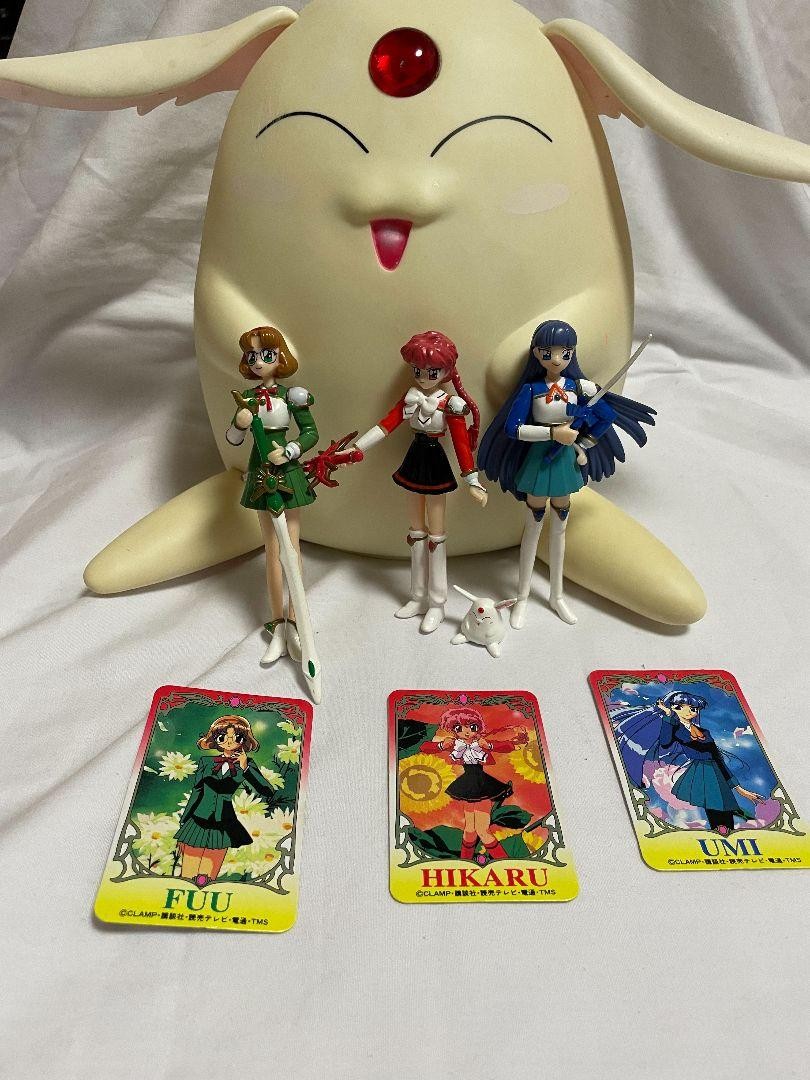
Lastly, a new anime project was announced to celebrate the 30th anniversary of the anime in July of 2024. It was later confirmed to be a modern remake of the anime series in the same vein as Urusei Yatsura and Ranma ½. This anime is set to air sometime this year on TV Asahi.
So, that’s (hopefully) everything I wanted to talk about related to this Clamptastic hidden gem on the Sega Saturn. While this was the last game on the Sega Saturn, I feel it deserves more recognition than just being “the system’s swan song.” It’s a game that played very well to the Saturn’s strengths and is emblematic of the best of the 2D games on the system.
The game has a good sense of humor, beautiful graphics, decent music, stunning FMVs, and fun gameplay. It’s an easy and cozy little adventure that I’d definitely recommend giving a try if you’re, in any way, a fan of the anime or manga, not that you’d need those to enjoy the game, mind you. If you do decide to play it, though, I might recommend just emulating it, unless you manage to win a Mr. Beast challenge or something so that you could afford it. But with that:
GTV Japan. (n.d.). Magic Knight Rayearth: The U.S. Saturn swan song was a winning strategy for games and anime in Japan [Video]. YouTube. https://youtu.be/O5FesW2Sm44
FantasyAnime. (n.d.). Magic Knight Rayearth. https://fantasyanime.com/magic-knight-rayearth/index
Hidden Palace. (n.d.). Magic Knight Rayearth (Sep 16, 1997 prototype). https://hiddenpalace.org/Magic_Knight_Rayearth_(Sep_16,_1997_prototype)
Lost Media Wiki. (n.d.). Magic Knight Rayearth (lost Summit Media Group English dub of anime; existence unconfirmed; 1995). https://lostmediawiki.com/Magic_Knight_Rayearth_(lost_Summit_Media_Group_English_dub_of_anime;_existence_unconfirmed;_1995)
Sega Retro. (n.d.). Magic Knight Rayearth (Saturn). https://segaretro.org/Magic_Knight_Rayearth_(Saturn)
The Cutting Room Floor. (n.d.). Magic Knight Rayearth (Sega Saturn). https://tcrf.net/Magic_Knight_Rayearth_(Sega_Saturn)
Retro Hangover Podcast. (n.d.). Interview with Victor Ireland (ft. Coury of MLiG & Joe of Game Sack) [Video]. YouTube. https://www.youtube.com/watch?v=ZVm0pWZfP3U